.webp)
'No hawker eviction this month', orders Calcutta HC in Raliway land encroachment case
.gif)

Download Mobile App 






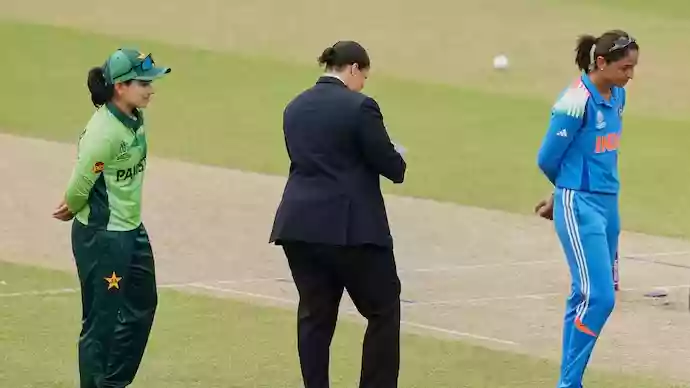
The high-stakes clash between India and Pakistan at the ICC Women's World Cup 2025 in Colombo was immediately overshadowed by a visible display of the strained political relationship between the two nations. Ahead of the group-stage fixture at the R. Premadasa Stadium, India captain Harmanpreet Kaur maintained the team's official 'no-handshake' policy against archrival Pakistan. This deliberate avoidance of the traditional exchange of pleasantries with Pakistan skipper Fatima Sana immediately drew attention, reaffirming the politicization of sporting ties.
The tense moment occurred during the official toss ceremony. Both captains walked out separately and, after Pakistan won the toss and opted to bowl first, they spoke to the broadcaster, Mel Jones, without making any eye contact or exchanging the customary handshake. The brief but pronounced diplomatic freeze at the toss mirrored the stance first adopted by the Indian men's team earlier this year during the Asia Cup, demonstrating a clear directive across all national squads.
The policy first gained widespread public and media attention during the men’s Asia Cup, where the teams met three times. It began when Suryakumar Yadav’s team notably refused to shake hands with the Pakistan players after their matches, including the final which India won. Sources within the BCCI confirmed that this move was not arbitrary but had the explicit approval of the Indian government, signaling that the directive is a part of the nation's broader diplomatic strategy concerning Pakistan.
The diplomatic frostiness reportedly escalated in the men's tournament when India also declined to receive the winners' trophy from Asian Cricket Council (ACC) president Mohsin Naqvi, who also serves as the Pakistan Cricket Board (PCB) chairman. This subsequent refusal, coupled with the initial no-handshake policy, further solidified the perception that sports are now inextricably linked to the geopolitical tensions between the two nuclear-armed neighbors.
The existing strained diplomatic relationship between India and Pakistan has notably deteriorated following the April conflict, which was sparked by a militant attack on tourists in Pahalgam. In the aftermath of the military confrontation, India is reported to have re-emphasized its firm position that bilateral sporting engagements with Pakistan remain entirely off the table, confining their interactions strictly to neutral venues during global or continental tournaments. The two nations have not played a bilateral series since the 2012-13 season.
Consequently, Sunday’s Women’s World Cup fixture in Colombo was played under a cloak of heavy security, reflecting the high-risk nature of the encounter. The continued adherence to the no-handshake policy by Harmanpreet Kaur's team serves as a public, non-verbal reiteration of India’s diplomatic position, making it clear that political sensitivities now supersede the tradition of sporting goodwill at the toss ceremony.





 West Bengal
 Bihar
Bihar Uttar Pradesh
 Jharkhand